
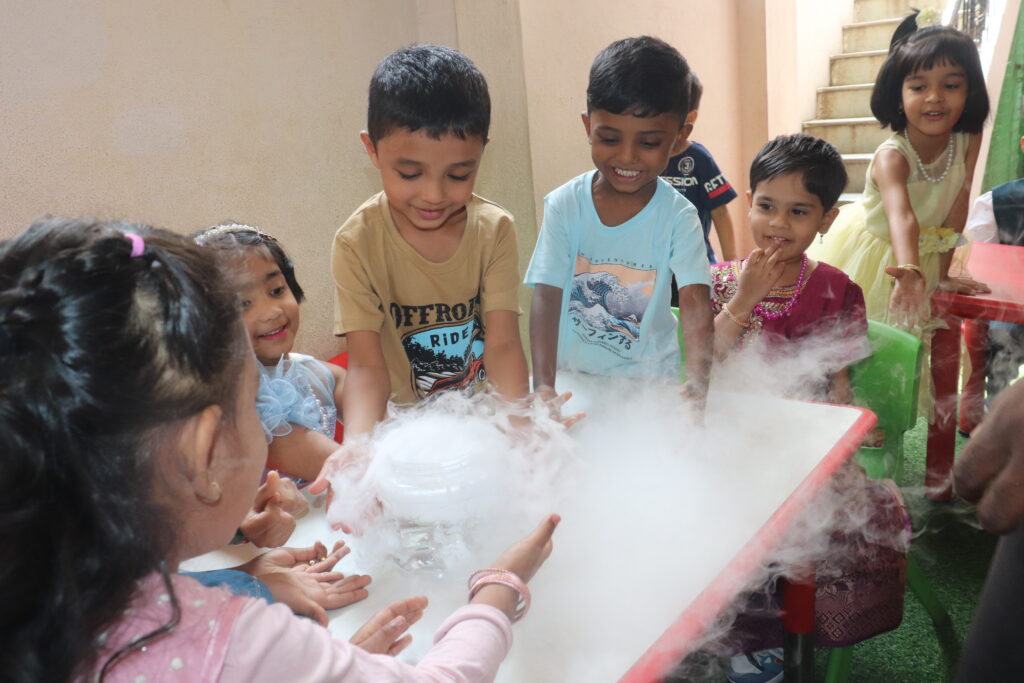
15 Simple Science Experiments for Kids at Home
The magic of simple science experiments for kids through our curated list of 15 Simple Science Experiments for Kids at Home, ideal for parents looking for interesting easy science experiments for kids and exciting science experiments for kids that don’t require any special equipment. These simple science experiments for kids at home and easy science experiments for kids at home using household materials transform common household items like baking soda, vinegar, and soap into a gateway of discovery that enables young minds between 4-12 years of age to learn concepts like chemistry, density, surface tension, physics, and more in a fun. Let’s get into the article.
Why Try These?
These easy science experiments for kids at home use science experiments using household items. The experiments cover various topics in science, including chemistry, density, and physics. They are the favourite of parents due to their simplicity and low mess.
Experiments Overview
| # | Experiment | Key Concept | Main Items Needed |
| 1 | Baking Soda Volcano | Chemical reaction | Baking soda, vinegar, bottle |
| 2 | DIY Lava Lamp | Density | Oil, water, food coloring, Alka-Seltzer |
| 3 | Magic Milk | Surface tension | Milk, food coloring, dish soap |
| 4 | Walking Water | Capillary action | Cups, water, food coloring, paper towels |
| 5 | Balloon Rocket | Newton’s Third Law | Balloon, straw, string, tape |
| 6 | Elephant Toothpaste | Chemical reaction | Hydrogen peroxide, yeast, dish soap |
| 7 | Skittles Rainbow | Diffusion | Skittles, plate, water |
| 8 | Oobleck | Non-Newtonian fluid | Cornstarch, water |
| 9 | Dancing Raisins | Buoyancy | Raisins, carbonated water |
| 10 | Static Butterfly | Static electricity | Balloon, tissue paper |
| 11 | Invisible Ink | Oxidation | Lemon juice, paper, heat |
| 12 | Rainbow Density Jar | Density layers | Honey, soap, water, oil, alcohol |
| 13 | Fizzy Balloon | Gas production | Baking soda, vinegar, balloon, bottle |
| 14 | Sticky Ice | Freezing point depression | Ice, string, salt |
| 15 | Mentos Geyser | Nucleation | Mentos, soda bottle |
Experiment 1: Baking Soda Volcano
Make a volcano using a bottle on a tray containing half-baking soda. Add vinegar to the bottle to observe the eruption. This is an acid-base reaction that creates carbon dioxide gas. Kids will be fascinated by the fizzing of the soda as the gas bubbles expand. This is one of the most popular simple experiments using household items for kids.
Safety: Do outdoors or over a tray.
Experiment 2: DIY Lava Lamp
Pour vegetable oil into the bottle until it is two-thirds full. Add water and food coloring. Insert an Alka-Seltzer tablet. The bubbles will move up and down the bottle as lava would. The oil will float on the denser water. The gas bubbles will move the colorful globules up and down. Insert more Alka-Seltzer tablets for continuous action.
Science Tie-in: Explains immiscible liquids in various science experiments for kids at home.
Experiment 3: Magic Milk
Add milk to a plate, add drops of food coloring, then touch with a soapy cotton swab. The colors spin around wildly.Soap dissolves surface tension on milk fat, causing colors to be pulled in. Use different colors to make interesting patterns.
Fun Fact: Perfect easy science experiment showing molecular action.
Experiment 4: Walking Water
Set three cups: colored water, empty, colored water. Connect with paper towel bridges. Water “walks” to mix colors. Capillary action draws water through towel fibers. Wait 1-2 hours for rainbows.
Extension: Use more cups for fuller spectrum.
Experiment 5: Balloon Rocket
String through straw, tape balloon to straw. Release air for zip along string. Air thrust propels balloon backward according to Newton’s law. Test balloon sizes.
Physics Lesson: Action-reaction in motion for science experiments for kids.
Experiment 6: Elephant Toothpaste
Combine dish soap and food coloring in bottle containing hydrogen peroxide and yeast. Foam will explode out of bottle.Chemical change of hydrogen peroxide to oxygen foam catalyzed by yeast. Use 3% hydrogen peroxide safely.
Wow Factor: Giant “toothpaste” tower.
Experiment 7: Skittles Rainbow
Arrange Skittles in circles on plate, and place in warm water. Watch how colors spread from the center. Colors spread from the center due to dissolving sugar, which carries colors via diffusion. Stirring is not necessary.
Visual Delight: Creates a radial rainbow.
Experiment 8: Oobleck
Combine 2:1 ratio of cornstarch and water. Squeeze and shape into solid and let go to become liquid again. Shear-thickening fluid has special properties. Punch or roll Oobleck.
Play Time: Mold like silly putty.
Experiment 9: Dancing Raisins
Put raisins in soda glass. Watch how they move up and down. Carbon dioxide bubbles stick to raisins, making them rise. Bubbles pop, and they fall. Try with grapes.
Repeatable: Refill soda for dances.
Experiment 10: Static Butterfly
Cut tissue paper, make a butterfly, rub a balloon on some hair, and hover near. Works. Static electricity attracts lightweight objects, like paper.
MagicTrick: Feels like levitation.
Experiment 11: Invisible Ink
Write on a piece of paper with lemon juice, let it dry, and shine a lamp on it. A brown color appears. Heat oxidizes citric acid.
Spy Game: Secret notes revealed.
Experiment 12: Rainbow Density Jar
Slowly layer honey, soap, colored water, oil, and alcohol in a bottle. Bands stay separate.Density is the weight per unit volume of a substance. Liquids with different densities stack.
Art Science: Vibrant display jar.
Experiment 13: Fizzy Balloon
Put baking soda in a balloon and balance it over a bottle containing vinegar. When you tilt, the balloon inflates.
Self-Inflating: No lungs are needed.
Experiment 14: Sticky Ice
String on the ice cube. Sprinkle salt on the string. The string gets embedded as it refreezes. The freezing point of the solution is lowered by the salt. So, the string gets melted and refrozen.
Puzzle Solved: Chemical chill.
Experiment 15: Mentos Geyser
Mentos dropped in the soda bottle. The spray will be tremendous if done in an outdoor area. The candy has many nucleation sites. Diet soda is recommended.
Spectacle: Do in open area.
Benefits and Tips
The benefits of these science experiments are the development of observation skills. These science experiments are best conducted by maintaining journals. Various science experiments are conducted using household items.
Safety Guidelines
Before proceeding with these science experiments for kids, it is necessary to follow safety guidelines. Adult supervision is a must for a fun experience with all the different science experiments for kids.
| Safety Concern | Precautions |
| Chemicals (vinegar, peroxide) | Use small amounts; wear goggles if sensitive |
| Messy spills | Use trays or do outdoors |
| Sharp edges | Avoid glass for young kids; supervise |
| Heat sources | Low heat only; no open flames |
| Choking hazards | Small items for older kids (6+) |
To conclude,15 science experiments for kids at home provide endless fun and learning through science experiments and science experiments for kids that require only household items. Parents can confidently engage their children aged 4 to 12 years in the exploration of science through science experiments.
FAQS
Q1: What age group are these simple science experiments for kids at home suitable for?
The easy science experiments and science experiments for kids are suitable for children aged 4-12 years. However, adult supervision is required for younger children and when experiments involve chemicals like hydrogen peroxide.
Q2: Do these simple science experiments for kids at home require any special materials?
No, all the science experiments for kids at home using common household materials require easily available ingredients like baking soda, vinegar, food coloring, and dish soap.
Q3: Are these science experiments for kids safe for indoor use?
Yes, most of them are safe for indoor use, except for a few that are very messy, like the science experiment for kids with the volcano, for which a tray is advisable, and the science experiment with mentos and geysers, which is better performed outside.
Q4: How long do this easy science experiments take for completion?
The science experiments for kids take only 5-10 minutes for setting up, and the experiments themselves take anywhere from 5 minutes, as in the case of the science experiment with mentos and geysers, to as long as 1-2 hours, as in the case of the science experiment with walking water.
Q5: Can we repeat and/or vary the science experiments for kids?
Yes, you can vary the experiments as per your wish, like using different coloured dyes, changing the number of items, and/or changing the items themselves, like using grapes instead of raisins.
Source:
45 Easy, At-Home Science Experiments for Kids
75 Easy Science Experiments Using Materials You Already Have
30 Simple Science Experiments for Kids at Home | Twinkl
Top 32 Science Experiments for Kids Using Materials you already have — Kids Science Labs
10 Fun Science Experiments for Kids to Try at Home